





When people start looking into double eyelid surgery, cost is one of the things they most often want to know. Yet even under the same name, the items that make up the cost change depending on which method is used, how far the surgery goes, and what is done at the same time. Instead of listing prices, this article explains what the cost is made of and why it is quoted differently from person to person.
Why is it hard to put one number on double eyelid surgery cost in Korea?
When you first look into double eyelid surgery, you may think something like this.
A common thought
Double eyelid surgery is all much the same, so surely there is one set price?
The non-covered fee notice on the 1mm Plastic Surgery Korean website carries this sentence: “Surgery fees may vary depending on the surgical method and the level of difficulty, which depend on each person’s condition.” The cost of double eyelid surgery is not set by the name of the surgery alone. It depends on the surgical plan made after examining your eyelids.
That is why this article does not list prices. Instead, it goes through the items that make up the cost and why those items differ from person to person.
What items make up the cost of double eyelid surgery?
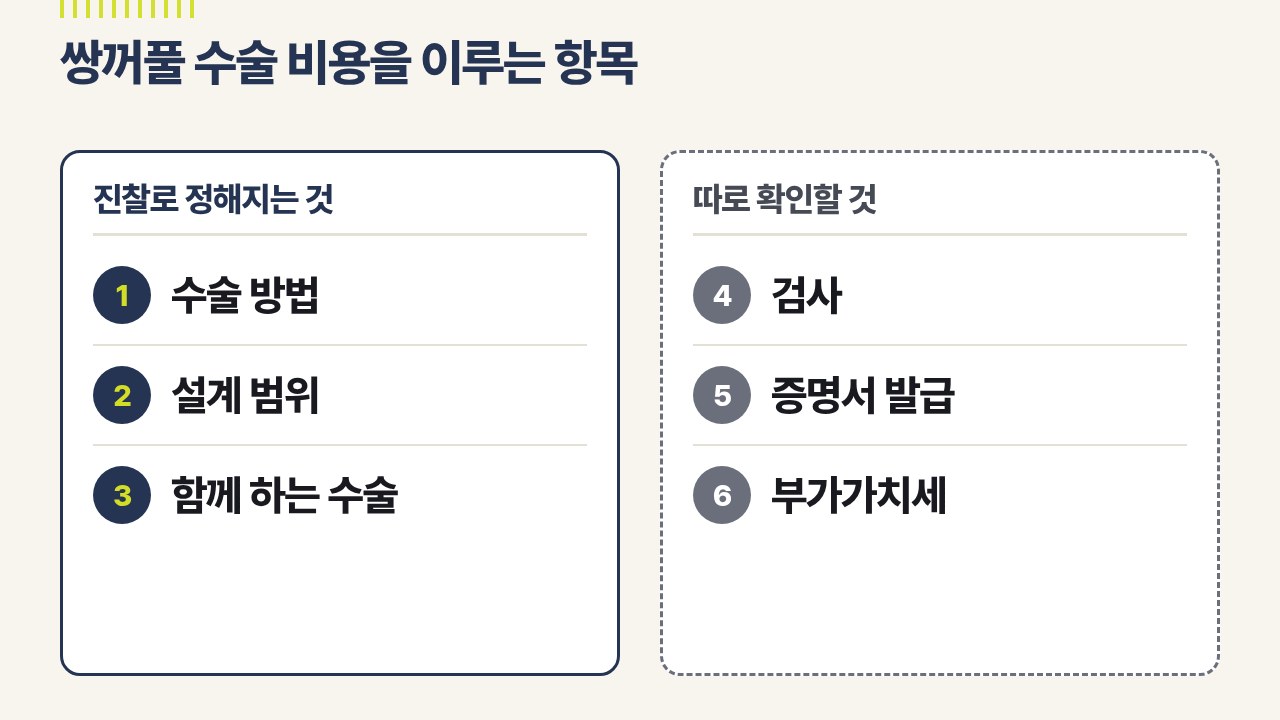
The cost can broadly be divided into items set at the examination and items to check separately. The first three depend on the condition of your eyes; the last three depend on the tests and documents you need and on how tax is handled.
| Item | What it is | What it depends on |
|---|---|---|
| Surgical method | Suture method (natural adhesion) or incisional method | Eyelid skin thickness and fat, skin sagging, eye-opening strength |
| Design scope | The number of fixation points (suture method), how much fat and muscle is trimmed (incisional method) | Eyelid condition, difficulty of the surgery |
| Combined procedures | Ptosis correction, canthoplasty, upper eyelid fat removal or grafting, etc. | The examination findings and the eye shape you want |
| Tests | Blood tests, etc. (if needed) | Explained at the consultation, depending on the surgical plan |
| Medical certificates | Medical certificate, medical certificate in English, doctor’s opinion, confirmation of treatment | The type of document you need |
| VAT | Tax charged on cosmetic plastic surgery | Whether it is included in the amount you are quoted |
The tests, certificates and VAT items are based on the ‘non-covered fee notice’ on the 1mm Plastic Surgery Korean website. Which items actually apply is explained after the consultation.
Double eyelid surgery for cosmetic purposes is a non-covered treatment, excluded from Korean national health insurance benefits. Clinics therefore set out non-covered items and fees separately. 1mm Plastic Surgery posts a non-covered fee notice in the announcements section of its Korean website (www.1mmps.com).
The first fork in the cost is the surgical method. The two methods differ in how the skin is handled and which tissues are trimmed.
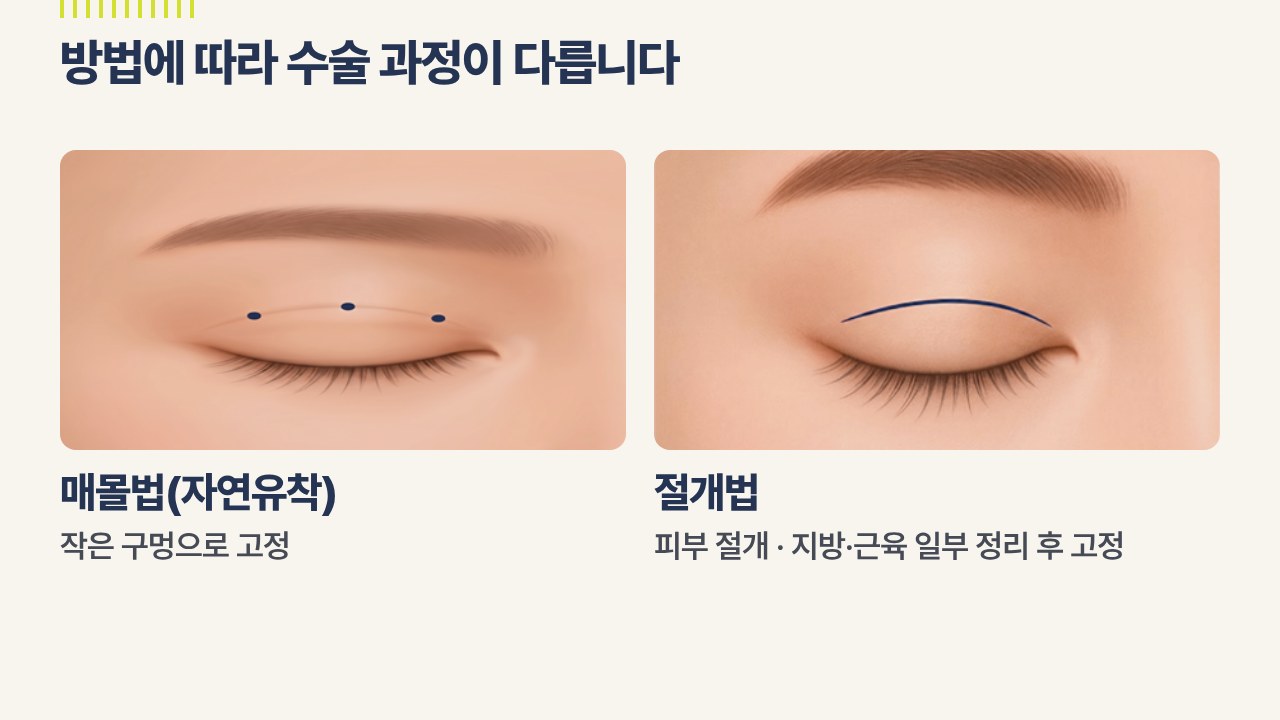
- Suture method — tiny openings are made in the skin and the line is fixed with knots tied inside the muscle. The clinic’s website describes it as the method recommended when the eyelid skin is thin, firm and not sagging.
- Incisional method — after the line is designed, the skin is incised and unnecessary fat and part of the muscle are removed. The incised skin is then fixed to the tarsal plate and the skin is closed. The website describes it as the method recommended when the skin sags considerably or the eyelid is thick.
The order matters
The method is not chosen by looking at the cost; it is decided after the structure of the eyelid has been checked.
You can read about both procedures at 1mm Plastic Surgery on the suture method (natural adhesion) double eyelid · incisional double eyelid pages.
Why does the cost differ from person to person even with the same method?
Even with the same method, suture (natural adhesion) or incisional, the surgical plan is different for each person, because eyelid conditions differ.
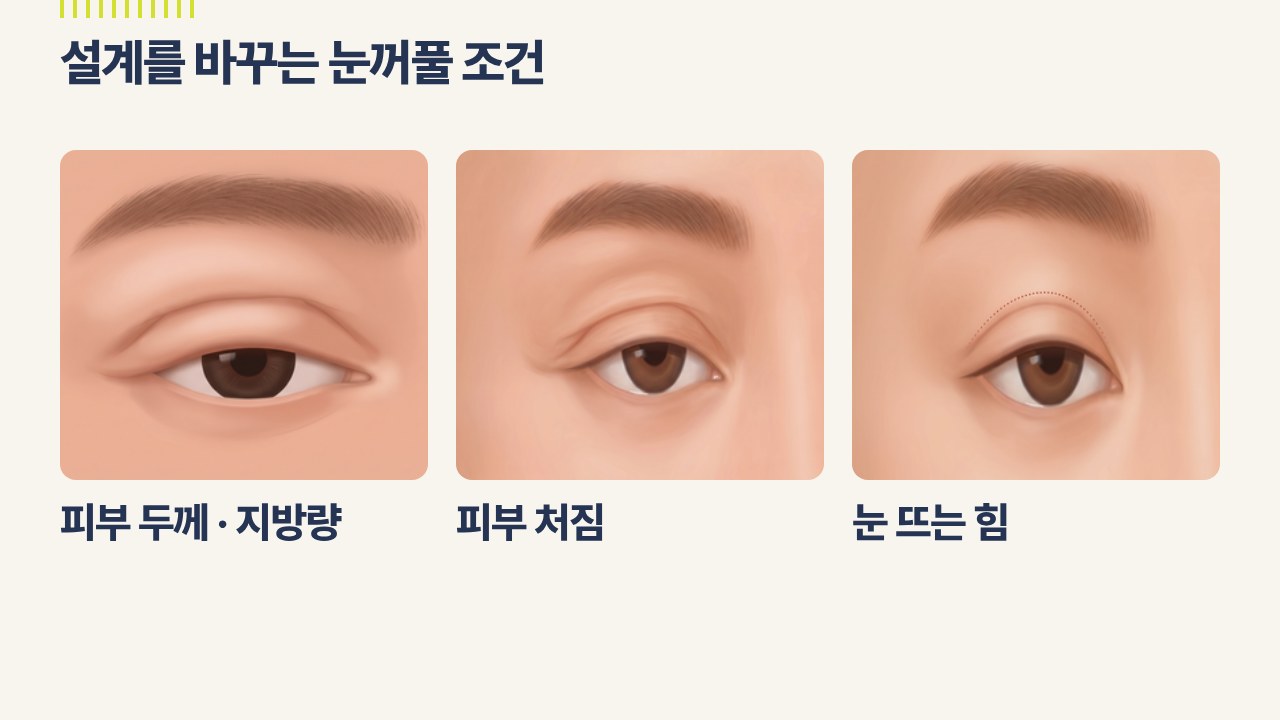
- Skin thickness and fat — if the eyelid is thick or there is a lot of fat in the upper lid, trimming that fat may be included in the plan.
- Skin sagging — if the skin hangs down, the incisional method may be considered.
- Eye-opening strength — at 1mm Plastic Surgery, the number of fixation points (holes) in the suture method (natural adhesion) is set according to eye-opening strength. According to the clinic’s website, 4 to 12 points are planned depending on the condition.
- Condition of each section — in the suture method (natural adhesion) at 1mm Plastic Surgery, each eye is divided into four sections, and the line is designed by looking at the muscle strength, skin condition and tissue volume of each section.
- Left–right differences — no face is perfectly symmetrical, so in the suture method (natural adhesion) at 1mm Plastic Surgery, separate surgical plans are made for the right and left eyes.
Because of these conditions, even for surgeries with the same name, the surgical plan and its difficulty are set differently for each person. As the 1mm Plastic Surgery non-covered fee notice states, the cost may vary depending on the surgical method and the level of difficulty.
If it is a revision
A revision works again on an eyelid that has already had surgery. Adhesions and scars from the earlier surgery and the current skin condition must be checked, and depending on the condition the incisional method may be needed. So for a revision, the plan and cost are set after the condition from the earlier surgery has been examined.
What changes if other procedures are done at the same time?
Double eyelid surgery is sometimes planned together with other eye surgery, such as ptosis correction, canthoplasty, or upper eyelid fat removal or grafting. When another procedure is added, it also becomes part of the cost.

- Ptosis correction — considered together when eye-opening strength is weak and the eyelid covers the pupil. Unlike surgery that only creates a line, it deals with the eye-opening function.
- Canthoplasty — surgery that refines the eye shape toward the inner, upper, outer or lower direction. On the 1mm Plastic Surgery non-covered fee notice, ‘canthoplasty’ is listed as a separate item from ‘eye surgery (suture method)’.
- Upper eyelid fat removal or grafting — may be considered together when there is a lot of fat in the upper lid or, conversely, when it is hollow.
Adding more is not the goal
With combined procedures, more is not necessarily better. The examination first checks whether your eyes need them, and they are added to the plan when they are judged necessary.
Are there costs to check besides the surgery fee?
Even after the surgical plan is set, a few items are worth checking separately.
- VAT — double eyelid surgery for cosmetic purposes is a treatment subject to value-added tax (Enforcement Decree of the Value-Added Tax Act, Article 35). The 1mm Plastic Surgery non-covered fee notice is marked VAT not included. Please check whether VAT is included in the amount you are quoted.
- VAT refunds for international patients — the special VAT refund for cosmetic surgery received by foreign tourists (Restriction of Special Taxation Act, Article 107-3) applies to medical services supplied up to and including 31 December 2025. As of November 2026, this deadline has not been extended.
- Tests — the non-covered fee notice lists tests such as blood tests as items separate from surgery. Any tests needed are explained at the consultation.
- Medical certificates — a medical certificate, a medical certificate in English, a doctor’s opinion and a confirmation of treatment have separate issuing fees. If you need documents for use abroad, please let us know in advance.
What should you ask at a cost consultation?
Asking the questions below at the consultation makes it easier to see what is included in the amount you are quoted and what is not.

- Which surgical method do you recommend for my eyes, and why?
- Which procedures are included in the quoted cost? — including any combined procedures
- Does the amount include VAT?
- Are there separate fees for tests or certificates?
- When should I come back for follow-up after surgery?
- What side effects are possible, and how are they handled?
About side effects
With both the suture method and the incisional method, results and the course of recovery may differ depending on the condition of each person’s eyes, and side effects such as swelling and bruising, left–right asymmetry, inflammation or infection, scarring and loosening of the line may occur. If you notice anything unusual after surgery, please tell the clinic that performed it right away. Procedures done at the same time, such as ptosis correction, canthoplasty, and upper eyelid fat removal or grafting, can each have side effects too, so please check them at the consultation as well.
Double eyelid surgery cost: frequently asked questions
Is VAT included in the cost of double eyelid surgery?
Double eyelid surgery for cosmetic purposes is subject to value-added tax. The 1mm Plastic Surgery non-covered fee notice is marked VAT not included. Please check at the consultation whether VAT is included in the amount you are quoted.
Can foreigners get a VAT refund on cosmetic surgery in Korea?
The special VAT refund for cosmetic surgery received by foreign tourists (Restriction of Special Taxation Act, Article 107-3) applies to medical services supplied up to and including 31 December 2025. As of November 2026, this deadline has not been extended.
Can I know the exact cost before the consultation?
The surgical method, the design scope and any combined procedures are set after your eyelids are examined, so the cost of your surgery is explained after the consultation.
Is the cost of double eyelid revision based on the same criteria as the first surgery?
A revision requires checking adhesions and scars from the earlier surgery and the current skin condition. Depending on the condition, the incisional method may be needed. So for a revision, the plan and cost are set separately after the examination.
What happens at the consultation
Before the amount,
we check the scope your eyes need
- Checking eyelid skin, fat and eye-opening strength
- Checking left–right differences and eyelid condition
- Explaining the surgical method and why
- Explaining the surgical plan and what the cost includes
We check the condition of your eyes and discuss a suitable surgical approach. Results and the course of recovery may vary from person to person.
Consultation and booking
| Enquiries |
[email protected]
Getting in touch in advance can help reduce your waiting time. |
|---|---|
| Telephone | +82-2-552-1171 |
| +82 10-9451-1171 | |
| Opening hours |
Weekdays 10:00 – 19:00 Saturday 10:00 – 16:00 Closed Sundays and public holidays — for holiday opening, please check the monthly schedule notice. |
| Address | 7th, 8th, 9th and 10th floors, Youngshin Building, 449 Gangnam-daero, Seocho-gu, Seoul
In front of Sinnonhyeon Station Exit 7, a 2-minute walk |
| Website | 1mmpsglobal.com |
#DoubleEyelidSurgeryCost #DoubleEyelidSurgeryKorea #KoreanDoubleEyelid #SutureMethod #IncisionalDoubleEyelid #EyelidSurgeryKorea #1mmPlasticSurgery #KoreanUnderEyeFatSurgery #EpicanthoplastySurgery #JuvelookSkinBooster
This post was written by the founder of a medical institution to provide medical information. The eye illustrations in this post are explanatory drawings used in 1mm Plastic Surgery videos and card news; they do not show real people and are not before-and-after images. The diagrams were drawn for this article to aid understanding. For any surgery, its suitability for you, the result and the course of recovery may differ depending on your eye condition, and side effects may occur. Costs are explained according to the surgical plan set through a consultation. Please confirm the details through a consultation.


