





[mdtoday=Reporter Shin Chang-ho] The appearance of the eyes significantly influences one's overall impression. Consequently, eye surgery is among the most in-demand plastic surgery procedures and has become a widely popularized field. However, with high demand comes a high incidence of reoperations due to dissatisfaction and side effects.
Therefore, to enhance surgical completeness and reduce the risk of reoperation, it is necessary to perform eye surgery that highlights individual characteristics rather than simply following trends. It is crucial to develop a personalized eye surgery plan that thoroughly considers the overall facial balance, as well as the condition of the periorbital muscles, skin, and fat tissues.
The most commonly performed double eyelid surgery can be divided into the non-incisional (suture) method and the incisional method. The appropriate surgical method can be chosen based on the individual's eye condition and the patient's needs. The non-incisional method involves creating tiny holes along the designed double eyelid line without incision, then inserting a thread and tying a knot. This method creates a natural double eyelid line, offers fast recovery due to the absence of incisions, and has less burden of scarring.
The incisional method involves skin incision along the double eyelid line. This allows for the removal of an appropriate amount of skin, muscle, and fat as needed, making it suitable for individuals with thick eyelid skin or a large amount of fat. While it carries a greater burden of scarring and recovery time compared to the non-incisional method, it can create double eyelids that are less likely to loosen. If there are symptoms of ptosis, performing only double eyelid surgery may result in the double eyelid appearing to loosen or creating a sleepy-looking eye. Double eyelid surgery only creates a line on the eyelid; correction of ptosis requires ptosis correction surgery. Ptosis correction surgery strengthens the power of the eye-opening muscle (levator palpebrae superioris) to increase the degree of pupil exposure.
By controlling the eye-opening muscles, ptosis symptoms are improved, making the eyes larger and clearer, thus creating a vibrant eye shape that doesn't look sleepy. It can also correct the habit of excessively using the forehead to open the eyes due to weak eye-opening strength, and prevent forehead wrinkles caused by this. Depending on the degree of ptosis and the eye condition, either the incisional or non-incisional method can be chosen.
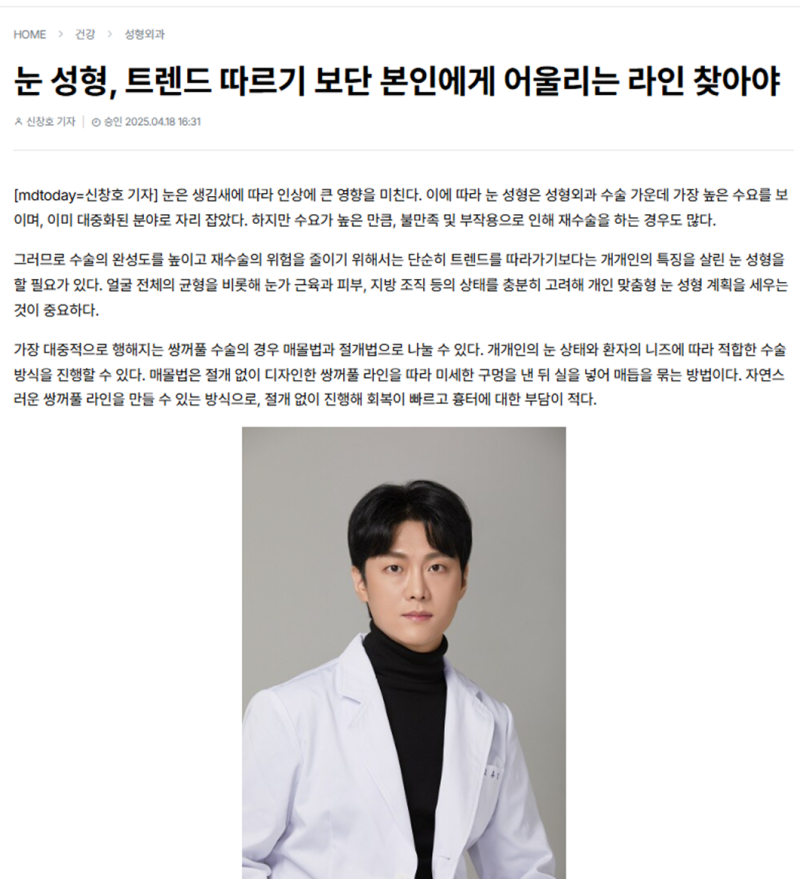
Director Kim Hong-jin of 1mm Plastic Surgery advised, ‘Rather than blindly following eye surgery trends, one should undergo eye surgery that is aesthetically suitable for their eye shape and functionally necessary to achieve satisfactory surgical results without regret.’ He added, ‘Since each patient has different eye shapes, eyelid skin thickness, fat amount, soft tissue condition, and degree of skin sagging, a surgical plan that considers these factors must be established.’
He continued, ‘It is important to accurately assess the patient's condition through careful and precise consultation, and comprehensively consider this to perform customized surgeries such as incision, non-incision, or ptosis correction.’
Medical Today Reporter Shin Chang-ho (ssangdae98@mdtoday.co.kr)
Source: Medical Today (https://www.mdtoday.co.kr)


