

When a double eyelid crease looks thick and puffy, like a sausage, it is easy to think, ‘If a little more fat is removed, it will get thinner.’ But eyelid fat can make the crease look puffy when too much is left, and removing too much can also lead to multiple creases. Removing more fat is not the only answer in sausage eye revision. This post explains how revision that removes differs from revision that fills (upper eyelid fat grafting), and what is considered when fat grafting is added.
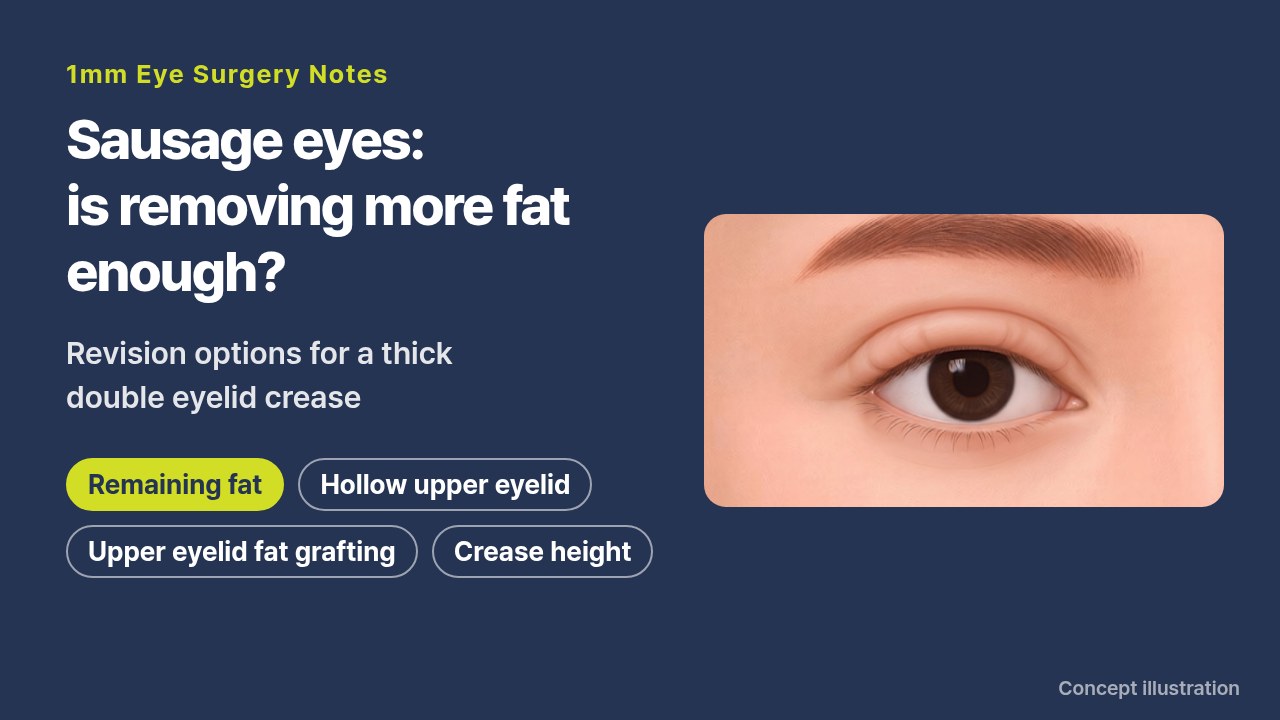
Sausage eyes: will removing more fat make the crease thinner?
A common thought
If a bit more fat is taken out, won’t the crease get thinner?
‘Sausage eyes’ is a common name for eyes where the crease has settled thick and unnatural-looking after double eyelid surgery, like a sausage. 1mm Plastic Surgery’s double eyelid revision information describes a thick crease (sausage eyelid) as a case where the crease was set too high, or unnecessary fat was not sufficiently removed. Depending on the cause, revision is then planned to create a natural-looking crease by removing fat or adjusting the crease height.
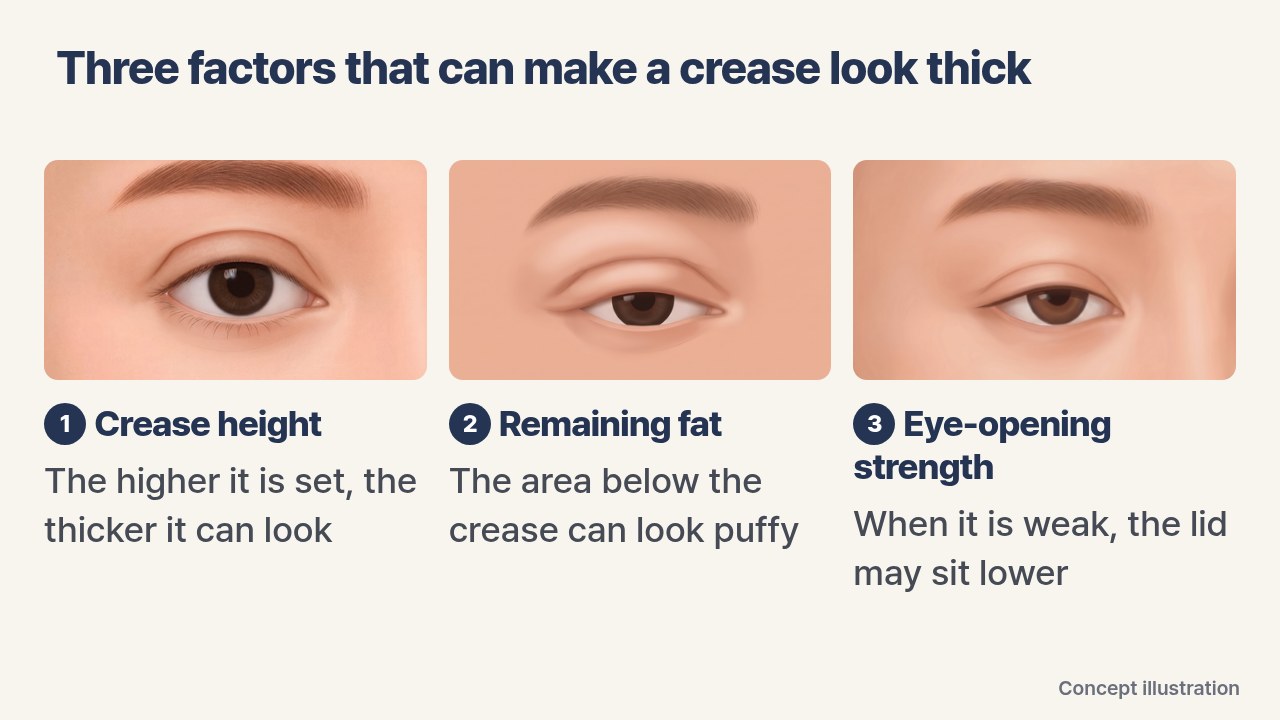
The website names two causes: crease height and remaining fat. An earlier 1mm Plastic Surgery article added a third: ptosis, weak eye-opening strength, that was not sufficiently corrected. Two or more of these can be mixed in the same eye, so which one plays the larger part is sorted out by examination rather than from photos. Revision to lower the crease is covered separately in ‘Can a High Double Eyelid Crease Be Lowered? What to Check Before Revision’, and the causes of eye revision in general, including uneven eyes, in “‘Eye Surgery’ Has Become Popular, Leading to Many Reoperations for Uneven Eyes and Sausage Eyes”.
This post looks closely at just one side of it: fat. Some eyes still have fat to remove, but others actually need filling. Both can look simply ‘off’ from the outside, yet the direction of revision is opposite.
Why can removing too much fat lead to multiple creases?
1mm Plastic Surgery’s double eyelid revision information describes fat-related problems in two opposite forms. One comes from removing too little, the other from removing too much.
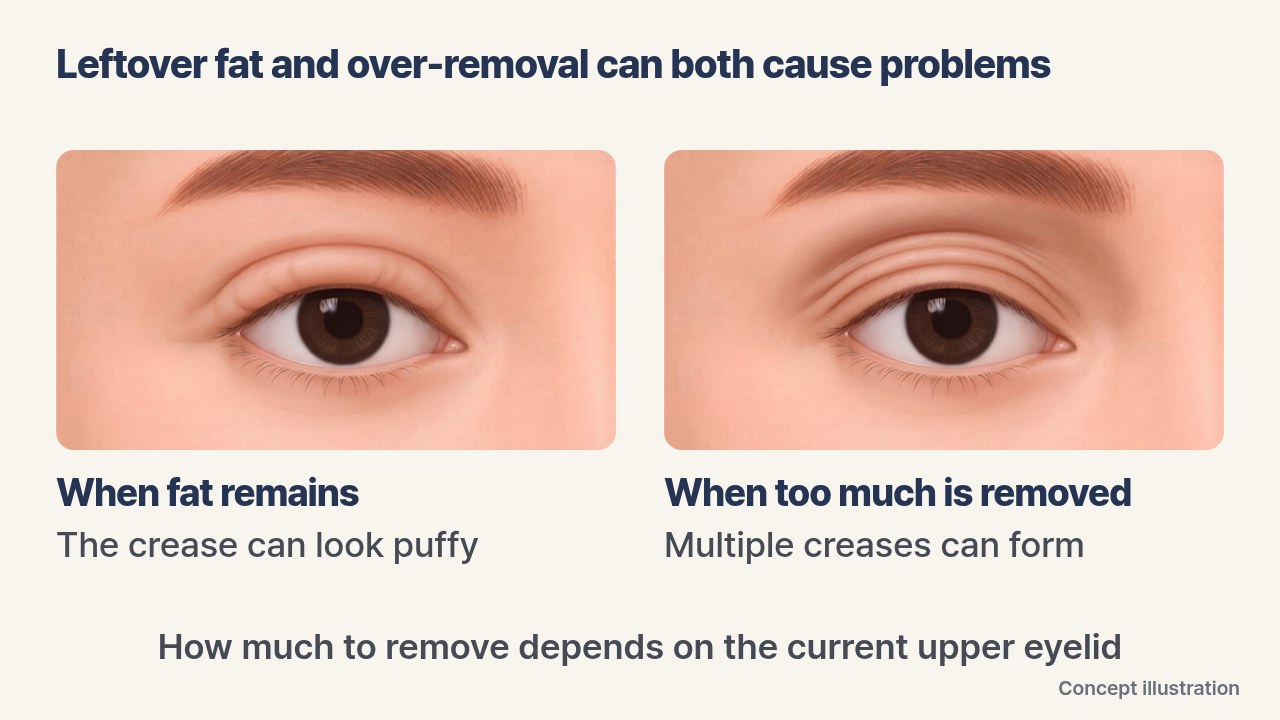
- Too little removed — If fat that should have been removed remains below the crease, the crease can look puffy, like a sausage. This is when removing the remaining fat is considered.
- Too much removed — The information explains that if fat, muscle or other tissue in the upper eyelid is removed excessively, the crease can form in layers. Here the direction considered is not removing more, but adding volume to the upper eyelid or fixing the crease into one line.
The upper eyelid fat grafting information also lists ‘a double eyelid that looks loose in multiple folds’ as a case for fat grafting. It also explains that when the upper eyelid is hollow, the crease may have difficulty settling properly. In other words, if fat keeps being removed to fix a thick crease, the concern can shift in the opposite direction. So fat is not a matter of ‘the more removed, the thinner’; it is a matter of deciding how much to remove by looking at the volume that remains.
How does revision that removes differ from revision that fills (upper eyelid fat grafting)?
Ways to fix a thick crease can broadly be divided into removing and filling. Adjusting crease height and removing remaining fat rework the crease and tissue left by the previous surgery. Upper eyelid fat grafting adds volume to a hollow upper eyelid. When eye-opening strength is weak, ptosis correction may be considered as well, and when causes overlap, several methods may be planned at once.
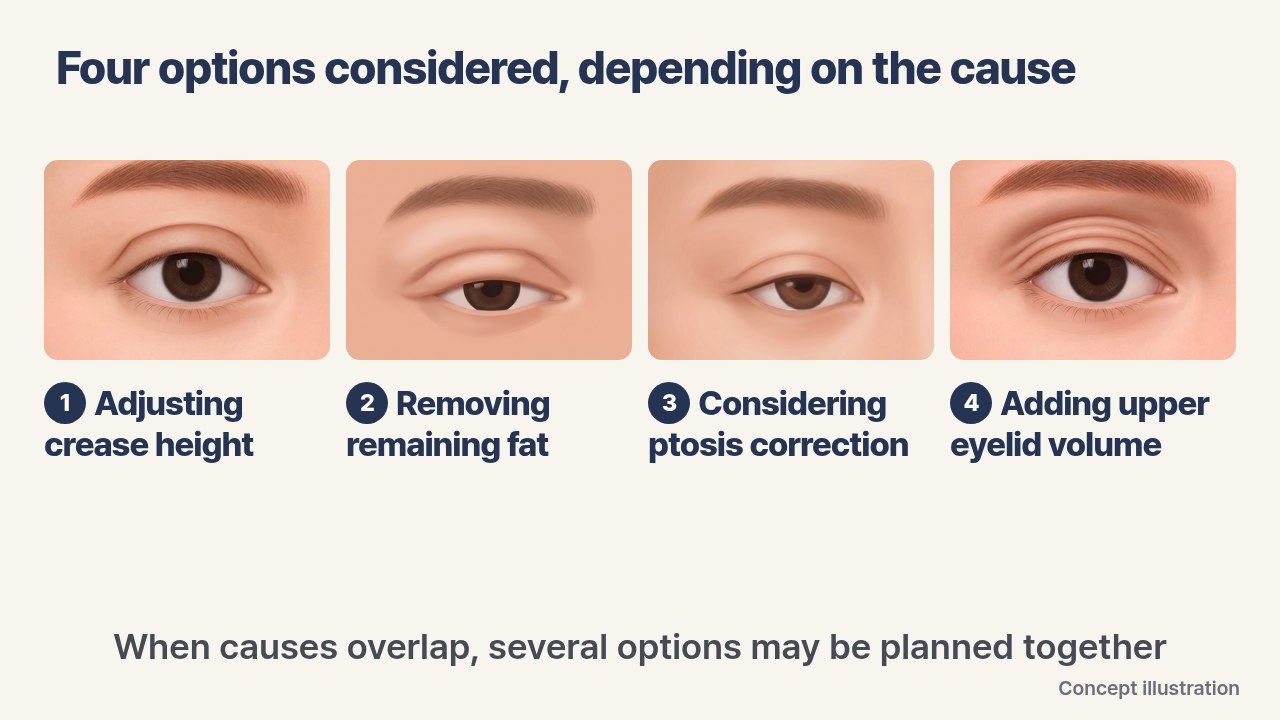
| Option | When considered, and the aim | Keep in mind |
|---|---|---|
| Adjusting crease height | When the crease was set too high, the crease height is redesigned with the aim of adjusting the thickness. | Because the eye has already had surgery, scar tissue and adhesions from the previous surgery are dealt with too. Depending on the tissue, achieving the exact height you want may be difficult in some cases. |
| Removing remaining fat | When unnecessary fat remains and the area below the crease is puffy, fat is removed with the aim of reducing the puffiness. | Removing too much fat or muscle can create multiple creases, so the amount is decided according to the condition of the upper eyelid. |
| Considering ptosis correction | When eye-opening strength is weak, how much of the iris shows is adjusted with the aim of improving a sleepy look. | Not every case of sausage eyes needs it. Whether to include it is decided after eye-opening strength is checked by examination, and the scope of surgery may change. |
| Adding upper eyelid volume | When the upper eyelid is hollow and there are multiple creases or the crease is hard to set, adding volume (upper eyelid fat grafting) is considered. | When the grafted fat settles poorly or the hollowing is very severe, a second fat graft is occasionally done. |
This table is not a comparison of which method is better; it summarises when each method is considered. The actual plan is decided after examination and consultation.
Removing means working again on the area of the previous surgery, so how the first surgery was done affects the plan. According to 1mm Plastic Surgery’s incisional double eyelid information, in the incisional method the skin is cut along the designed line, unnecessary fat and part of the muscle are removed, and the cut skin is joined to the tarsal plate (a firm plate inside the eyelid) to fix the crease. In revision, the scar tissue and adhesions left from that surgery are looked at too. The cases for revision and the improvement methods by cause that the website describes are gathered in 1mm Plastic Surgery’s double eyelid revision information.
What is considered when upper eyelid fat grafting is added?
Upper eyelid fat grafting moves fat taken from another part of the body to the upper eyelid to fill a hollow area. According to 1mm Plastic Surgery’s information, fat is harvested from the buttocks, thighs or abdomen, and the amount to graft is planned after assessing the extent and shape of the hollow, the muscle, the skin and other factors. Fat grafting can also be done on its own in eyes that have had double eyelid surgery.
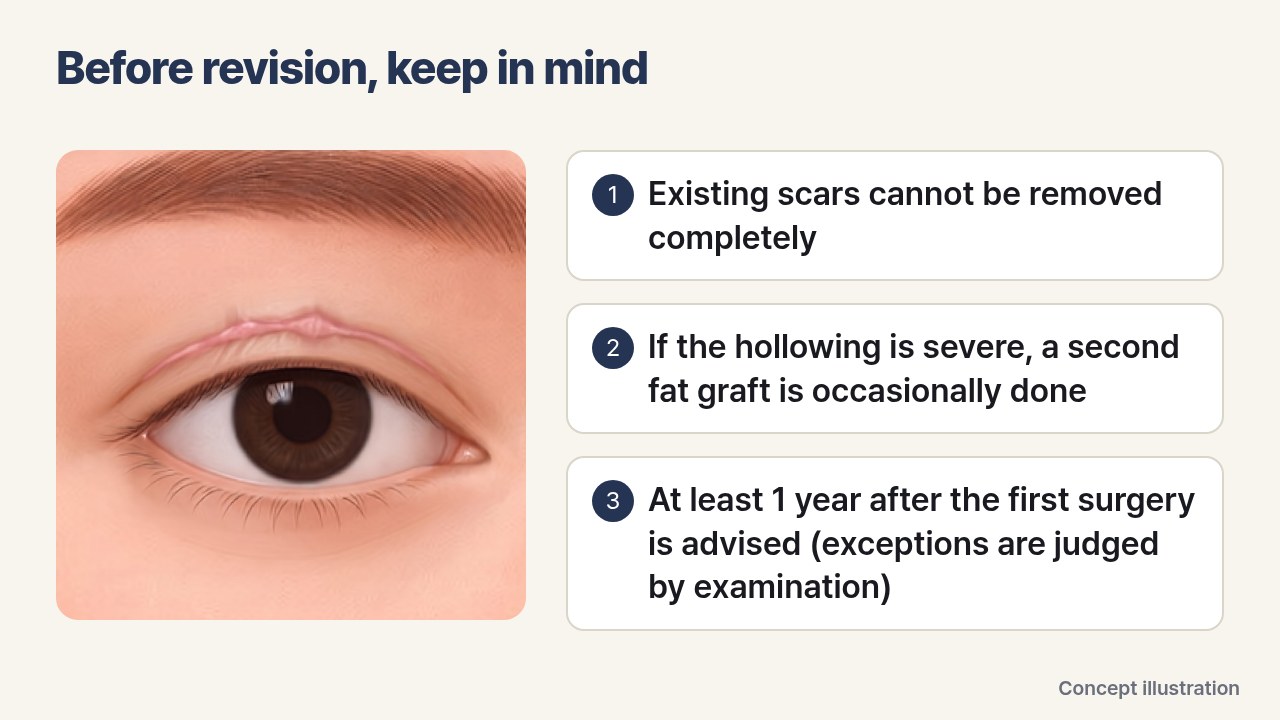
- Separating where to remove and where to fill — The upper eyelid fat grafting information stresses placing the right amount in the right position for the degree of hollowing. If it is combined with crease revision, where to reduce and where to fill within the same eye are divided in one plan.
- It may not be finished in one session — In some cases one graft is enough. However, when the grafted fat settles poorly or the hollowing is very severe, a second fat graft is occasionally done.
- Scars from the previous surgery — The revision information stresses removing scar tissue from the previous surgery and reducing tissue damage during surgery. However, existing scars cannot be removed completely. Revision is planned with the size and position of the scar in mind, so that as little additional scarring as possible is left.
Side effects and precautions
Common recovery reactions — Swelling, bruising and differences between the two sides may occur. The course of recovery differs from person to person and is checked through consultation.
Scarring — A scar may form at the incision site, and existing scars cannot be removed completely.
Inflammation and infection — Inflammation or infection may occur after surgery. If anything feels wrong, please contact the clinic and have it examined.
Changes in the crease — Even after revision, depending on your tissue and recovery, the crease may loosen, look like multiple folds or otherwise look different from what you expected.
Upper eyelid fat grafting — Depending on how well the grafted fat settles, the volume may differ from what you expected, and a second fat graft is done in some cases.
Remaining fat or a hollow upper eyelid: how is it told apart in a consultation?
1mm Plastic Surgery’s information explains that in the consultation, what you are currently unhappy with, what the medical team sees as the problem and the improvement you want are checked together before the surgical plan is discussed. Based on that information, we have set out in four steps how a sausage eye consultation usually proceeds.
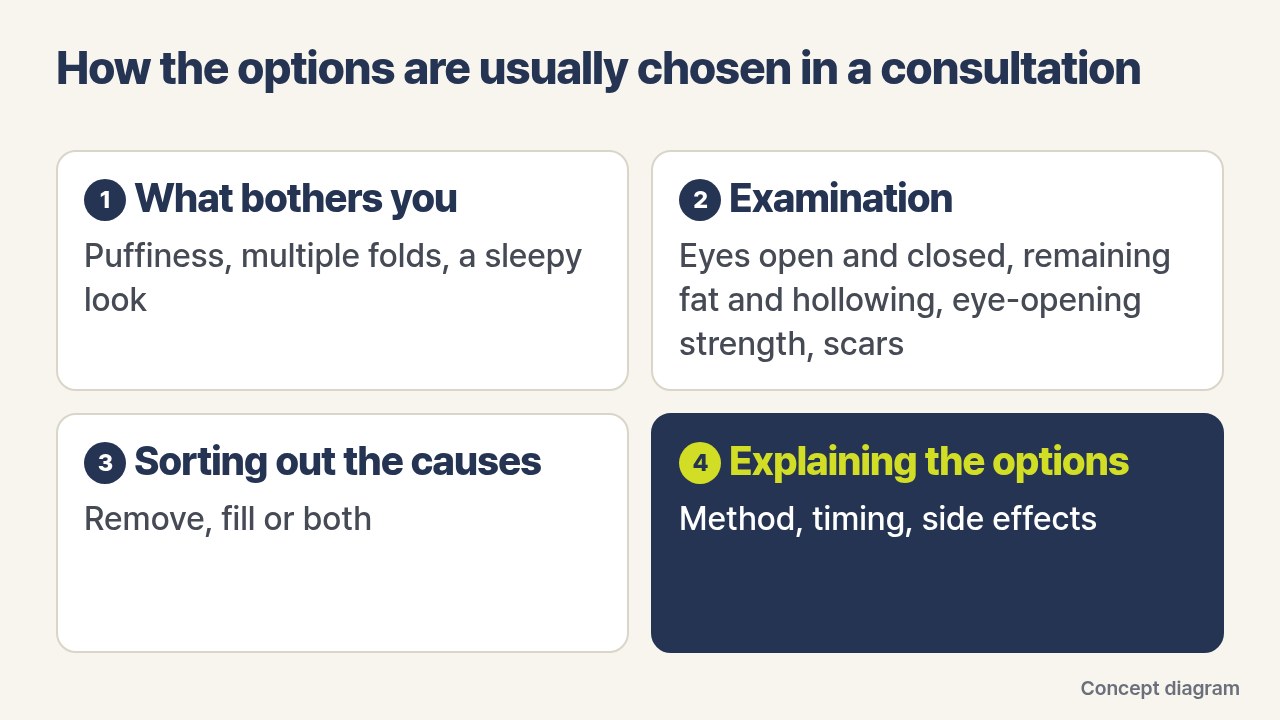
- Hearing what bothers you — The conversation starts with which bothers you most: the crease looking puffy, looking like multiple folds or the eyes looking sleepy.
- Examination — The crease with the eyes open and closed, fat remaining below the crease, the extent of hollowing in the upper eyelid, eye-opening strength and differences between the sides, and scars and adhesions from the previous surgery are checked.
- Sorting out the causes — Whether something is left to remove, whether an area now needs filling, or both, is sorted out. Whether eye-opening strength also needs attention is decided at this step.
- Explaining the options — The methods suited to the cause, the timing and possible side effects are explained.
Before the consultation, it helps to note when and how the first surgery was done (whether it was the suture method or the incisional method, as far as you know), whether you were told fat was removed at that time, and when the crease started to look thick. Even with sausage eyes, the plan may differ if the remaining fat and the condition of the upper eyelid differ.
Sausage eye revision: frequently asked questions
How long after the first surgery can sausage eye revision be done?
1mm Plastic Surgery’s information advises at least 1 year after the first surgery, and depending on the surgeon’s judgement, revision is sometimes done in the early period after surgery. The reasons for waiting and the exceptions are explained in ‘How Soon Can You Revise Double Eyelid Surgery? Why the Wait Matters’.
How can I tell whether I need ptosis correction?
It is estimated from how much of the iris shows. 1mm Plastic Surgery’s information explains that exposure of up to 80% of the whole iris is considered normal, and that less than this can give a sleepy look, in which case ptosis correction is recommended. An accurate judgement is confirmed through examination and consultation.
What if my eyes look hollow after fat was removed?
If the upper eyelid is hollow and multiple creases form or the crease has difficulty settling, filling rather than removing is considered. According to 1mm Plastic Surgery’s information, upper eyelid fat grafting can be done on its own, even for eyes that have had double eyelid surgery. The amount and position are decided after the degree of hollowing is examined.
What happens in a consultation
First, we separate where to remove
from where to fill
- Looking at fat remaining below the crease
- Looking at how far the upper eyelid is hollow
- Examining eye-opening strength and scars
- Explaining methods, timing and side effects
We look at your previous surgical history together with the current upper eyelid, then talk about whether removing or filling should be considered. Results and the course of recovery may differ from person to person.
Consultation and booking
| Enquiries |
[email protected]
Getting in touch in advance can help reduce your waiting time. |
|---|---|
| Telephone | +82-2-552-1171 |
| +82 10-9451-1171 | |
| Opening hours |
Weekdays 10:00 – 19:00 Saturday 10:00 – 16:00 Closed Sundays and public holidays — for holiday opening, please check the monthly schedule notice. |
| Address | 7th, 8th, 9th and 10th floors, Youngshin Building, 449 Gangnam-daero, Seocho-gu, Seoul
In front of Exit 7, Sinnonhyeon Station — a 2-minute walk |
| Website | 1mmpsglobal.com |
#SausageEyes #SausageEyesFix #ThickDoubleEyelid #DoubleEyelidRevision #RevisionDoubleEyelidSurgery #PtosisCorrection #UpperEyelidFatGrafting #EyeSurgeryKorea #1mmPlasticSurgery #EpicanthoplastySurgery #WideNoseReductionRhinoplasty #JuvelookSkinBooster
This post was written by the founder of a medical institution to provide medical information. The procedure information is based on the double eyelid revision, incisional double eyelid, ptosis correction and upper eyelid fat grafting/removal pages of 1mm Plastic Surgery’s website and on earlier 1mm Plastic Surgery articles. The eye images in this post are concept illustrations and diagrams made to aid understanding; they do not show real people and are not before-and-after images. For any surgery, its suitability for you, the result and the course of recovery may differ depending on your eye condition and surgical history, and side effects may occur. Please confirm the details through a consultation.