





Three minutes into the consultation. Nothing has been decided yet, but you have already heard six unfamiliar terms. Incisional, non-incisional, epicanthal fold, lacrimal caruncle, in-out line, ptosis correction. If you can’t follow them, the conversation ends at “whatever you think is best, doctor.” So we have set them out in advance. Eight terms, that’s all.
First — why knowing the words helps
The purpose of a consultation is to establish what is possible for your eyes and what is not. But if you follow only half the explanation, your questions shrink to a single one: “will I look better?” Knowing the terms makes your questions specific instead.
“With my eyelid thickness, would incisional or non-incisional suit me?” “With my epicanthal fold, is an in-line possible?” — once you can ask like that, the same ten minutes gives you far more to take home.
The eight terms below are not a menu for choosing a procedure — they are a list for understanding the explanation. Which method suits you can only be determined by examining your eyes directly.
The first fork in the road — incisional and non-incisional
TERM 01 / 08 · Incisional method (절개법)
A method that makes an incision in the eyelid skin to form the crease.
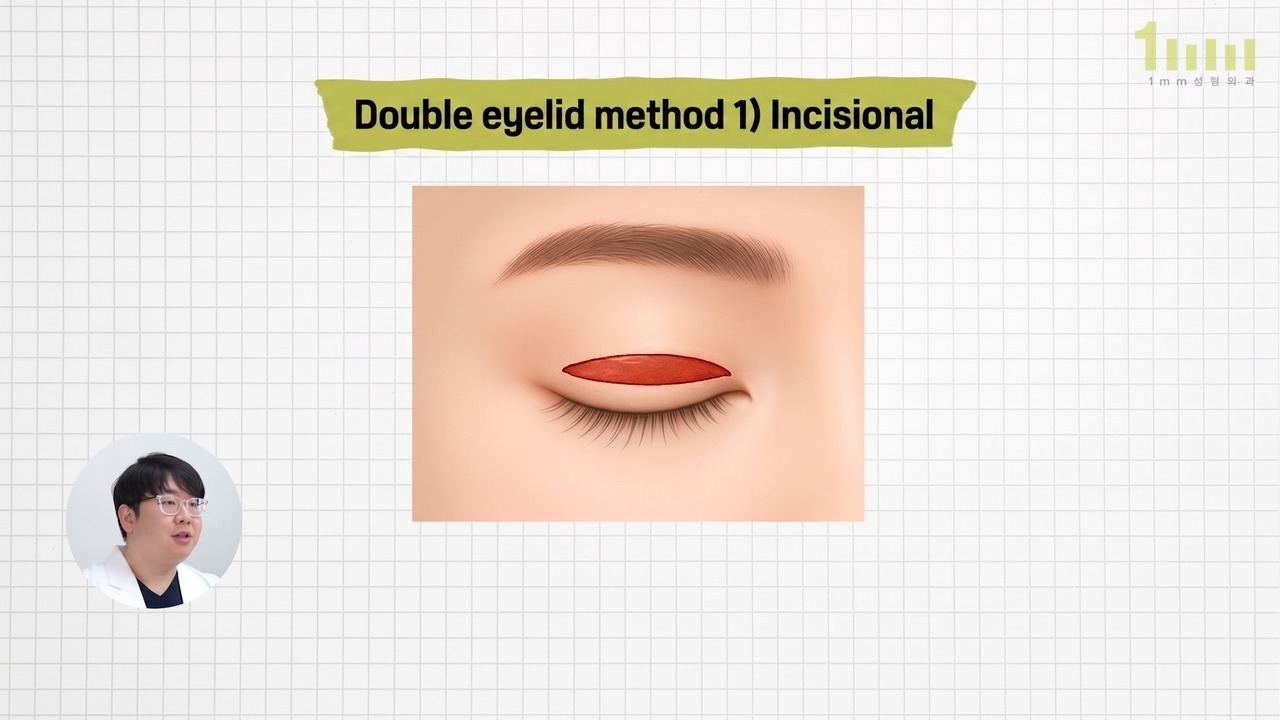
Because the skin is opened, the surgeon proceeds while checking the condition inside the eyelid directly. That is why a discussion about incision also looks at skin thickness, fat volume and degree of sagging. These factors help determine whether an incisional approach may be appropriate.
TERM 02 / 08 · Non-incisional method (비절개법)
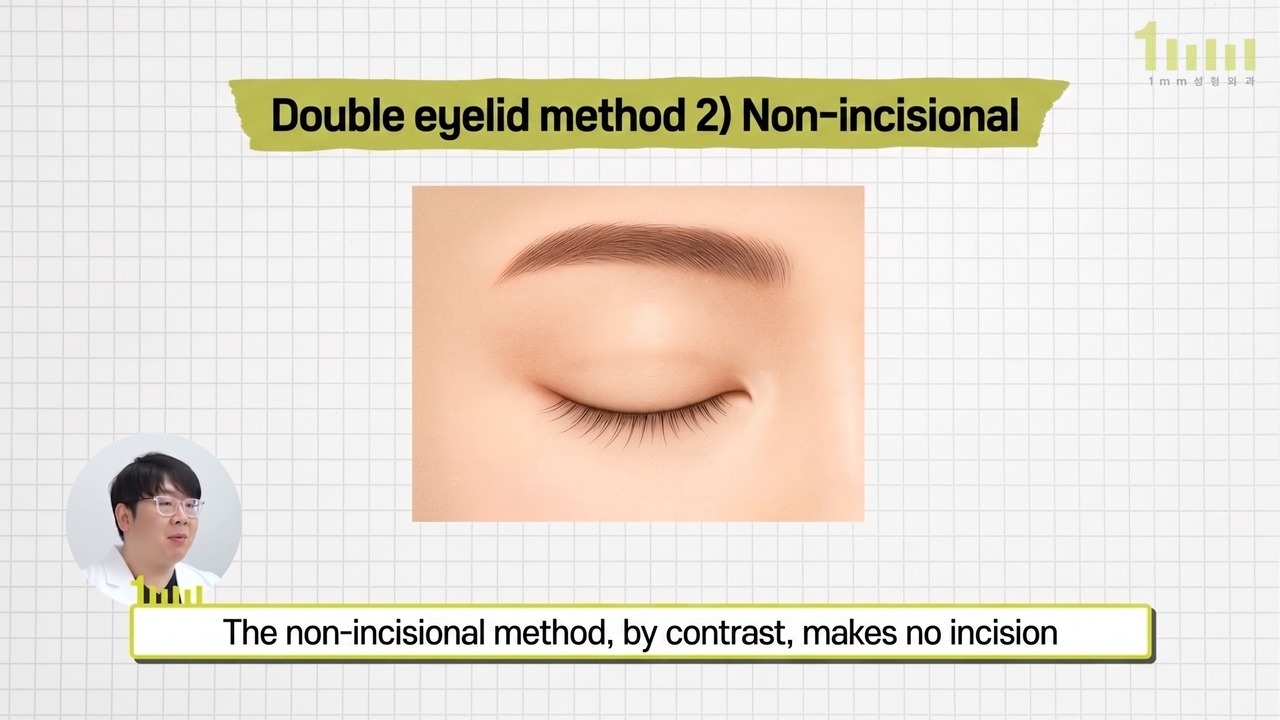
A method that forms the crease through small openings or fixation points rather than a continuous incision. In consultation it also goes by names such as the buried-suture or natural-adhesion method.
[What you actually hear in consultation]Which is better, incisional or non-incisional?— the question we hear most often, though in truth there is no “better” side.
Neither method is inherently better; each is suited to different eyelid conditions. The same answer cannot apply to someone with thin eyelids and someone with thick ones, or to someone with little fat and someone with a lot. So rather than picking a method first, a consultation checks the items below first.
| What we check in consultation | Why we look at it |
|---|---|
| Eyelid skin thickness | Thickness changes the conditions under which a crease holds |
| Eyelid fat volume | Affects how heavy the lid looks and how the crease forms |
| Skin sagging | With sagging, a crease alone may not resolve the appearance |
| Eye-opening strength | The basis for judging whether ptosis correction is also needed |
| Shape of the epicanthal fold | Changes the range of creases that can be achieved |
The items in the table are things we check; they are not criteria that guarantee a result. The actual judgement is made through examination.
Two unfamiliar names that come up every time — epicanthal fold and lacrimal caruncle
TERM 03 / 08 · Epicanthal fold (몽고주름)
A fold of skin that covers the inner corner of the eye. It governs how much of the inner corner is exposed.
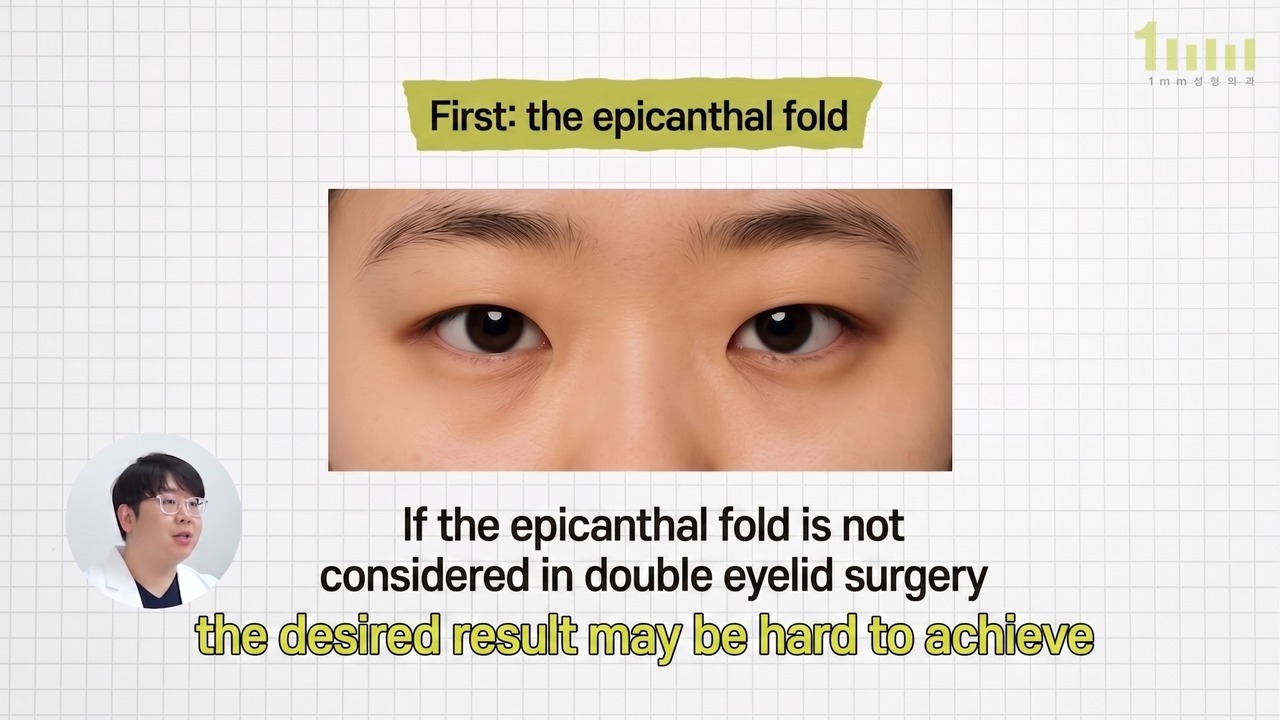
The reason the epicanthal fold keeps coming up is simple: the crease begins right on top of this fold. If the fold covers much of the inner corner, the crease runs inside it; if it covers little, the crease shows further forward. This is the first reason the same crease looks different on different people.
TERM 04 / 08 · Lacrimal caruncle (누호 · 눈물언덕)
The pink area visible at the inner corner of the eye. How much of it shows changes the overall impression of the eye.
[What you actually hear in consultation]Your caruncle is barely visible.— neither praise nor criticism. It is a description of your current state, said before any talk of epicanthoplasty.
The appearance of the epicanthal fold and the amount of caruncle exposure are closely related. When the fold covers the caruncle the eye can look slightly shorter; when the caruncle is widely exposed the eye can look sharper. So when planning epicanthoplasty, we look at “what the current state is” before “how much to open.” Opening more does not always lead to a better result.
Before you save that photo — in-line and in-out line
TERM 05 / 08 · In-line · In-out line · Out-line
A classification by where the crease passes at the inner corner. An in-line crease begins within the epicanthal fold. An in-out line starts within the fold and becomes visible farther outward, while an out-line remains visible from the inner corner.
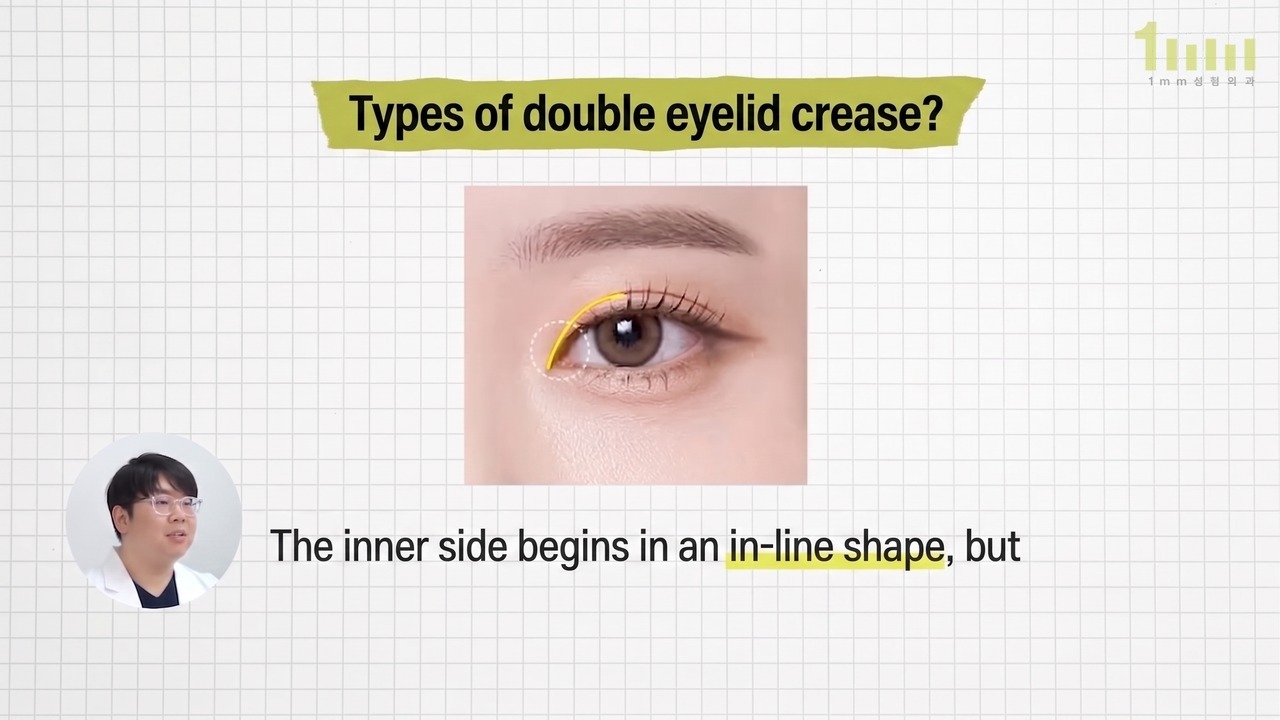
This is where consultations most often diverge. You show a saved photo and say “I want this crease,” and the answer that comes back is sometimes “that crease may be difficult.”
A crease is not a drawing placed on the eyelid but a result that sits on top of your eye structure. Where the epicanthal fold, skin thickness and eye-opening strength differ, the same crease turns out differently. It works far better to bring the “feel” of the crease in the photo rather than that person’s crease itself.
When you bring photos
Two or three works better than one. Showing a photo you like alongside one you find “a bit too much” conveys your intended range far more precisely.
When you hear “we should do these together” — canthoplasty · ptosis correction · fat removal
Talk about double eyelids tends to bring other procedure names with it. It can sound like an upsell, but they are in fact separate procedures with different sites and different purposes. Simply knowing what each one touches makes the decision far easier.
TERM 06 / 08 · Eye-opening surgery (Canthoplasty, “Teu-im”) (트임 · 앞/위/뒤/밑)
A collective term for procedures that adjust the shape or position of the inner or outer eye corners.
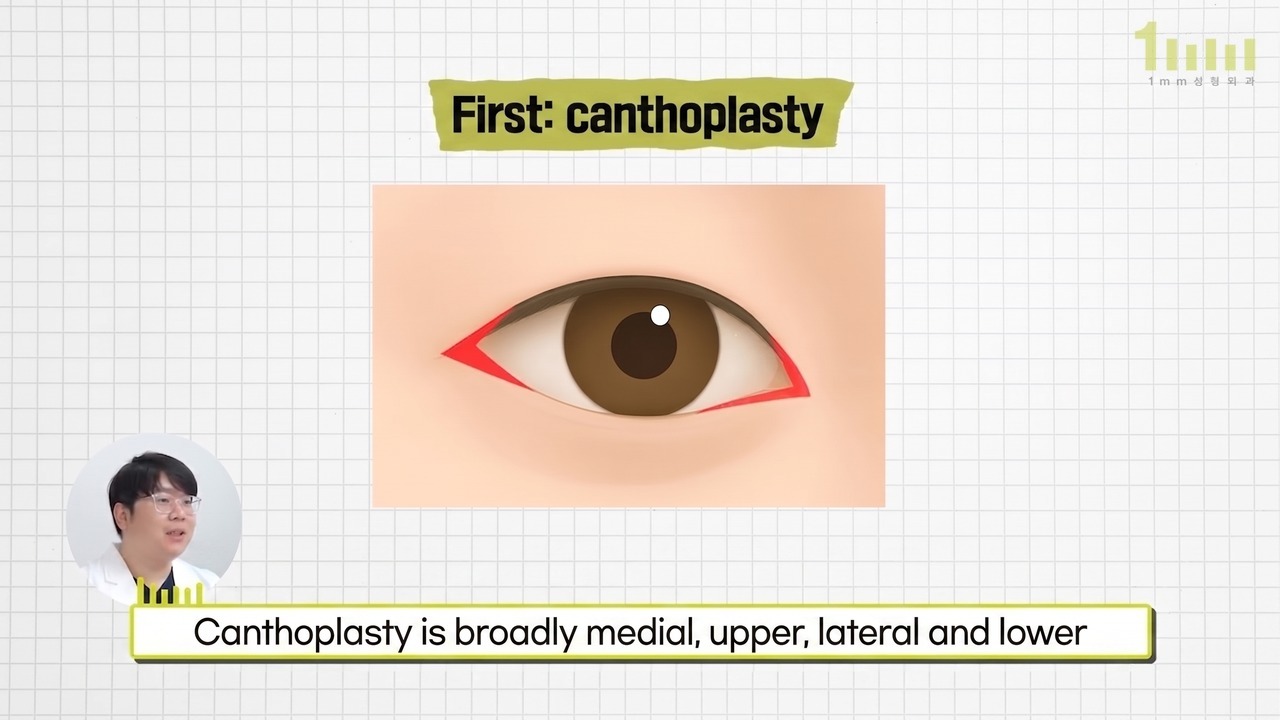
| Name | Edge adjusted |
|---|---|
| Medial (앞트임) | Inner corner — assessed together with the epicanthal fold and caruncle |
| Upper (위트임) | The upper edge of the eye |
| Lateral (뒤트임) | The outer corner |
| Lower (밑트임) | The lower edge of the eye |
Types are distinguished by which edge is adjusted. Whether any is needed, and how far, is judged after checking eye width, the epicanthal fold and the shape of the outer corner.
“I want bigger eyes, so I should get an eye-opening procedure.” But that’s actually the wrong way to approach it. Only after checking how wide the eye currently is and what shape the inner and outer corners have does which edge, and how far get decided.
TERM 07 / 08 · Ptosis correction (눈매교정)
A procedure that addresses eye-opening strength rather than the crease. It relates to how much of the iris is exposed.
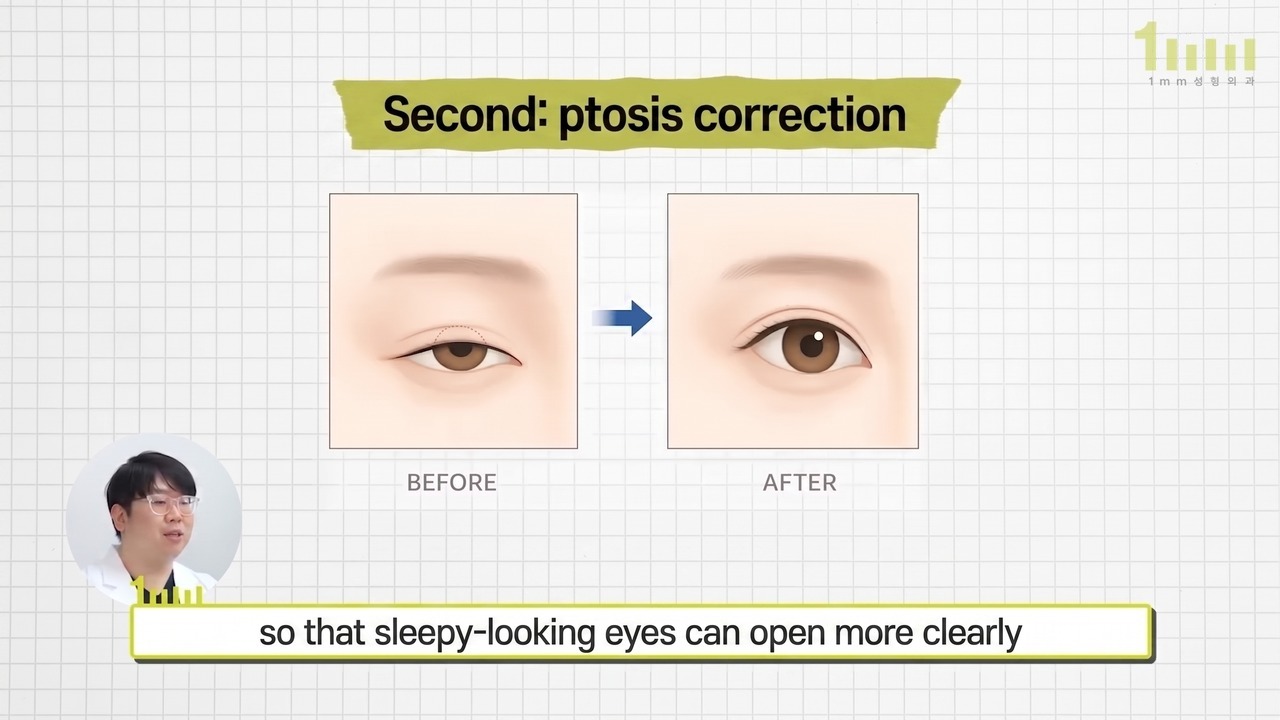
Double-eyelid surgery and ptosis correction get confused because both are talked about as “making eyes look bigger.” But what they address differs. Double-eyelid surgery looks at the crease; ptosis correction looks at eye-opening strength.
So having double-eyelid surgery does not mean everyone needs ptosis correction. Conversely, there are cases where a crease alone will not reach the impression you want. That judgement requires directly examining eye-opening strength.
TERM 08 / 08 · Fat removal (지방제거 · 눈꺼풀 지방)
A procedure that adjusts the amount of fat inside the eyelid. More removal is not necessarily better.
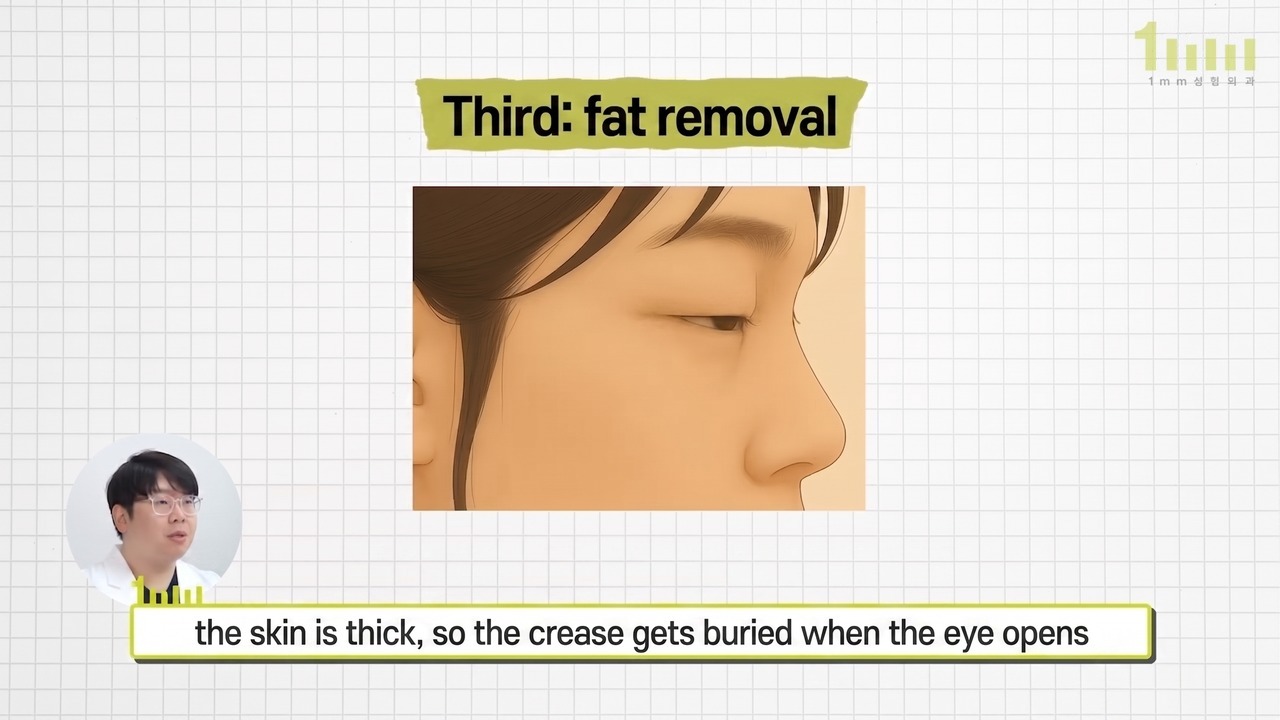
Where there is a lot of fat the lid can look heavy, and a crease that has been made may be buried and hard to see. In such cases adjusting the fat is considered alongside.
That said, fat is something to adjust, not something to eliminate. Volume around the eye is part of what makes an impression, so it is not a structure where removing more is better. How much is appropriate can only be decided by looking at the present condition.
A checklist for those ten minutes
You do not need to memorise all eight. Preparing just these five changes how much a consultation yields.
- Bring two or three photos — one you like and one you find too much. Your intended range comes across precisely.
- “With my eyelid thickness, which would suit me?” Ask by your own condition rather than by procedure name.
- “With my epicanthal fold, which crease is possible?” A question that establishes the achievable range first.
- “Why is this better done together?” Ask the reason behind any procedure recommended alongside.
- Recovery time and scheduling. How fast swelling subsides varies a great deal between individuals, so it is worth checking against your own calendar.
What this article covers
What you have read so far is what the terms mean. Which method suits you and what should be done together can only be known by examining your eyes directly, and results and recovery differ from person to person.
Frequently asked questions
Which is better, incisional or non-incisional?
It is difficult to say either is better. The two are options with different approaches, and which suits you depends on eyelid skin thickness, fat volume, degree of sagging and eye-opening strength. A consultation checks those conditions before choosing a method.
If I bring a photo of the crease I want, will it turn out that way?
The same crease appears differently on different people, because eye structures such as the shape of the epicanthal fold, the eyelid skin and eye-opening strength differ. A photo is good material for conveying the direction you want, but the achievable range is established through examination.
If I have double-eyelid surgery, must I have ptosis correction too?
Not for everyone. Double-eyelid surgery creates the crease, while ptosis correction addresses eye-opening strength and how much of the iris is exposed. Whether it is needed is judged after checking eye-opening strength.
If I have an epicanthal fold, is the crease I want difficult?
Closer to “the starting position of the crease changes” than to “difficult.” Depending on how much the fold covers the inner corner, the crease may run inside it or show further forward. Epicanthoplasty is sometimes considered alongside, but the decision also takes into account how much the caruncle is exposed.
Is removing more eyelid fat better?
No. Volume and structure around the eye differ between individuals, and fat is also part of what creates an impression. Adjustment is considered where the crease gets buried, but the appropriate amount is judged after checking the present condition.
Is canthoplasty essential for bigger-looking eyes?
It is not essential. Medial, upper, lateral and lower canthoplasty each adjust a different edge, and whether any part is needed is judged after checking eye width, the epicanthal fold and the shape of the outer corner.
What happens in consultation
Through examination and consultation with a board-certified
plastic surgeon, we carefully assess your individual eye condition and anatomy to determine an appropriate surgical plan with you
- Care by board-certified plastic surgeons
- Detailed analysis of your individual eye condition
- One-to-one consultation and surgical planning
- Safety and outcomes first
We examine your individual eye condition and structure closely, and find a suitable surgical direction together with you.
Consultation and booking
| Enquiries | global@1mmps.com Getting in touch in advance helps reduce your waiting time. |
|---|---|
| +82 10-9451-1171 | |
| Opening hours | Weekdays 10:00 – 19:00 Saturday 10:00 – 16:00 Closed Sundays and public holidays — for holiday opening, please check the monthly schedule notice. |
| Address | 7th, 8th, 9th and 10th floors, Youngshin Building, 449 Gangnam-daero, Seocho-gu, Seoul |
| Website | 1mmpsglobal.com |
#DoubleEyelidSurgery #EyelidSurgery #Blepharoplasty #EyeSurgeryTerms #IncisionalMethod #NonIncisional #EpicanthalFold #LacrimalCaruncle #InOutLine #DoubleEyelidCrease #Canthoplasty #PtosisCorrection #EyelidFatRemoval #GangnamPlasticSurgery #KoreanPlasticSurgery #1mmPlasticSurgery
This post was written by the founder of the medical institution for the purpose of conveying public-interest information, in accordance with Article 56(1) of the Korean Medical Service Act. The images are explanatory frames from the video “What to know before a double-eyelid consultation | Eye surgery terms explained,” produced by 1mm Plastic Surgery; they are not patient photographs for before-and-after comparison. For every procedure, suitability, results and recovery may differ according to the individual’s eye condition, and side effects may occur. Please confirm details through an examination.


